Guam in July | Independence Day, Liberation Day & Travel Tips
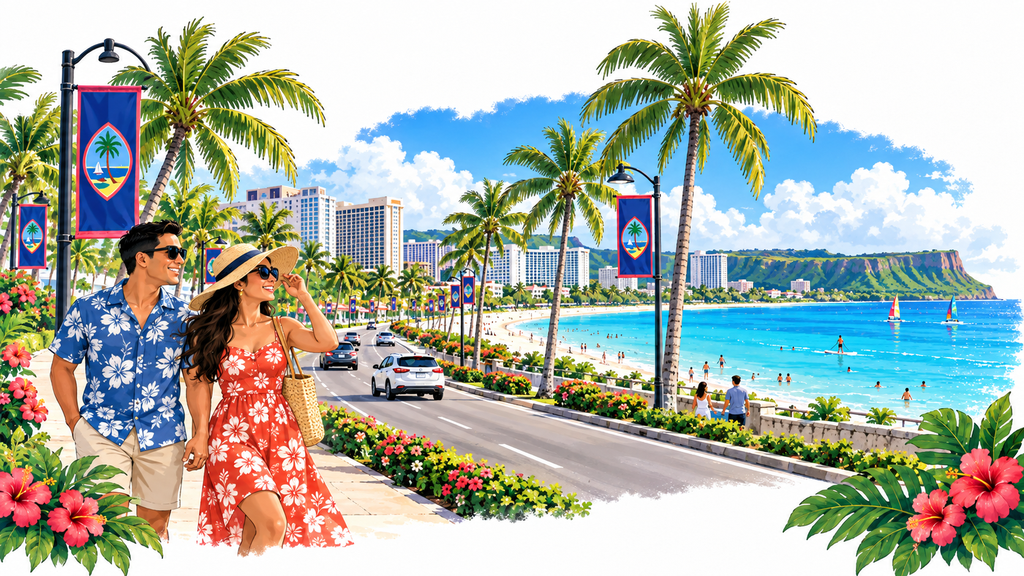
July Packs More Holidays Into One Month Than Any Other
Guam goes through plenty of months with no holiday at all, but July is a different story entirely. Two public holidays land in the same month: Independence Day on July 4 and Guam Liberation Day on July 21. And these two don't carry the same weight. Independence Day is simply Guam observing the same holiday as the rest of the country. Liberation Day is something else — it's Guam's own holiday, and the single most important date on the island's calendar. Between the parade, the festival, the fireworks, and a string of village fiestas happening at the same time, July is, for better or worse, the busiest month of the year to be on Guam. Worth knowing before you plan a trip.
Independence Day (July 4)
Guam observes July 4 the same way the mainland and all 50 states do. In years when the date falls on a weekend, the holiday shifts to the nearest weekday — if July 4 lands on a Saturday, for instance, the Friday before (July 3) becomes the observed holiday.
There's a real reason Guam celebrates this the same way the mainland does. On August 1, 1950, President Truman signed the Organic Act of Guam, which granted U.S. citizenship to the people living on Guam at the time and their descendants. In other words, Independence Day isn't "someone else's holiday" here — it belongs to the people of Guam as U.S. citizens in their own right. The day typically opens with a flag-raising ceremony, followed by parades and marching band performances, family barbecues, and afternoons spent in the water at the beach — much the same scene you'd find anywhere in the U.S. Some military facilities open events to the public too, like the Freedom Rocks! fireworks show at Sumay Marina on Naval Base Guam, which typically kicks off around 8 p.m.
Guam Liberation Day (July 21) — A Defining Island Commemoration
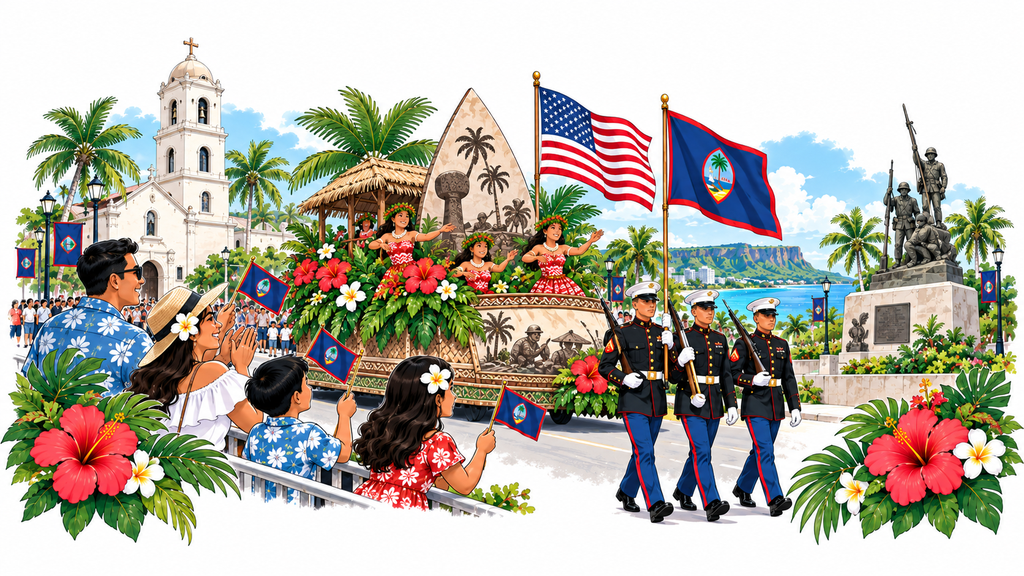
Nothing on Guam's calendar carries more weight than Liberation Day. Between the parade, the festival, and the fireworks, it's literally the island's biggest annual event — but behind the celebration sits a history that's never treated lightly.
Two Years and Eight Months of Japanese Occupation
On December 8, 1941, almost simultaneously with the attack on Pearl Harbor, Japanese aircraft bombed Guam. Two days later, on December 10, Japanese forces landed and occupied the island. Under occupation, Guam was renamed Omiya Jima; the capital, Hagåtña (then commonly called Agana), became Akashi; the village of Asan became Asama Mura; and Hågat (Agat), the village this page covers later on, became Showa Mura. Men were conscripted into labor building the Orote and Jalaguac (Kalaguac) airfields, women into farm work, and when public schools reopened in mid-1942, students were required to bow toward the Japanese emperor every morning before class. The occupation lasted roughly two years and eight months, until organized Japanese resistance ended on August 10, 1944.
July 1944: The Forced March to Manenggon, and Massacres
With the American invasion approaching, Japanese commanders on July 10, 1944 ordered CHamoru civilians across the island evacuated from their villages and marched to camps in the mountainous south — from as far north as Yigo and as far west as Hågat, infants and elders alike, carrying whatever little they could. The largest of these camps, Manenggon, sat on both banks of the Ylig River and is thought to have held as many as 15,000 people at its peak. Many died there of injury, exhaustion, dehydration, hunger, and disease like dysentery — though no exact death toll from the camps survives.
Amid that chaos, on July 15 and 16, Japanese soldiers massacred more than 40 CHamoru men and women at Tinta and Faha, near the southern village of Malesso' (Merizo). Two days after American troops landed, on July 23, a further massacre took place in a cave by Fena Lake near Sumay, where young men and women — many in their late teens — were killed. These events are a stark reminder that even after the July 21 landings, the violence in the island's interior wasn't over. Across the full occupation, an estimated 1,170 CHamorus were killed, and 14,721 more endured suffering that included torture, forced labor, and sexual violence.
The Manenggon camp itself wasn't reached by American troops until the afternoon of July 30, with the 77th Division fully overrunning it on July 31 — more than a week after the landings began. For many CHamorus, the moment of true liberation wasn't July 21 at all, but this later day.
July 21, 1944, and the End of the Battle
On July 21, 1944, the 3rd Marine Division landed at Asan while the 1st Provisional Marine Brigade landed at Hågat, flanking the strategically vital Apra Harbor between them. It was far from an easy fight — 455 Marines were killed at Hågat alone on the first day. By the time the battle ended on August 10, American forces had suffered 1,760 killed and 6,012 wounded; Japanese losses are recorded at 18,377 killed.
From a Quiet Thank-You to Guam's Biggest Celebration
Barely a year after the fighting ended, in 1945, local educator Agueda Iglesias Johnston persuaded U.S. military leadership to hold a commemorative celebration for the liberation — the very first Liberation Day. A queen contest was added in 1948, and in 1951 the holiday was formally written into law through Bill 35, introduced by Speaker Antonio B. Won Pat. Born out of wartime grief and hardship, the day has grown over the decades into something the CHamoru people themselves use to tell the story of their own resilience — and pass it on to the next generation.
The Parade and Festival
Today's Liberation Day celebration builds gradually toward July 21, with memorial ceremonies and commemorative Masses held at sites across the island from around July 10 onward — Carigande, Mangilao, the Asan Landing, Chaguian, Inalåhan, and Sumay among them. The centerpiece is a roughly five-hour parade that departs Adelup (near the Governor's complex) in Hagåtña and runs along Marine Corps Drive, the highway that runs the length of the island, all the way to Paseo de Susana. A Liberation Block Party fills Chamorro Village with food stalls, music, and cultural performances the day before and on the day itself, and the island also hosts an early-morning Liberation 5K and Liberation Mile, plus a fireworks show that evening. The 82nd celebration, in 2026, carried the theme "Para I Onra, Para I Gloria" ("For Her Honor, For Her Glory").
Because the parade occupies Marine Corps Drive — the island's main north-south highway — for hours at a time, expect significant impact along that route on the day. Exact timing and the lineup of related events can shift year to year, so check the Guam Visitors Bureau's official site as your trip gets closer.
July Village Fiestas — Southern Hågat (Agat)
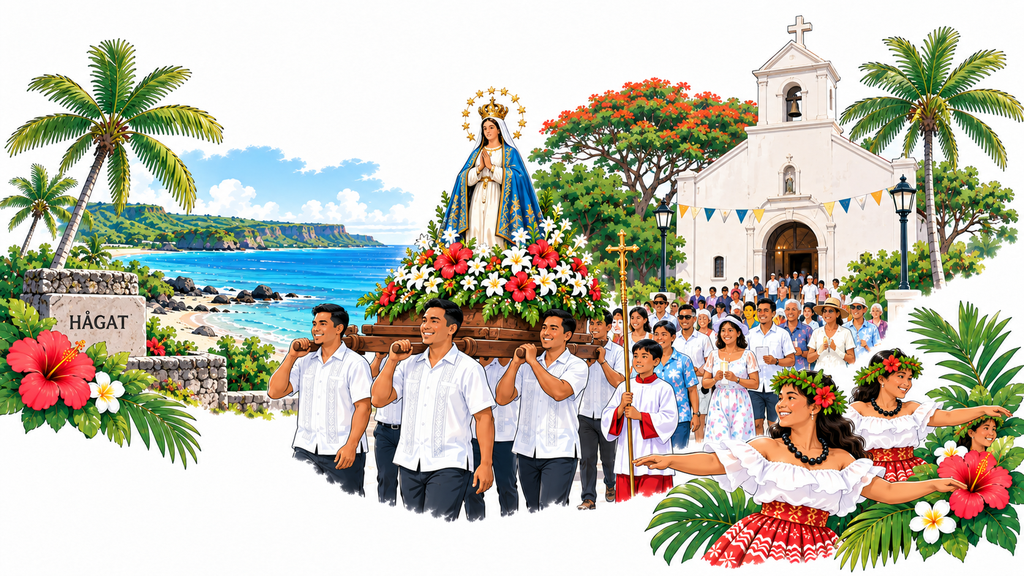
Hågat (Agat), one of the landing sites of the liberation itself, hosts back-to-back village fiestas in July. The first honors Our Lady of Mount Carmel, centered on Mount Carmel Catholic Church (157 South Eugenio St, Hågat, Guam 96915). Typically held in mid-July — July 11 in 2026 — the fiesta begins around 5 p.m. with a procession carrying a statue of the Virgin Mary through the village, followed by a Gupot feast built around fresh local seafood — much like the San Dionisio Fiesta in Humåtak that October's page covers, and just as rooted in the community rather than staged for visitors.
The second fiesta honors Santa Ana, the patron saint of Christian mothers, and is typically held in late July (the church sets the exact date each year — one source lists July 25, though it can shift). Hågat itself is one of southern Guam's larger villages by both size and population, first laid out in the 1680s under Spanish rule as a settlement for islanders who had rebelled.
July Weather and Tropical-Cyclone Readiness
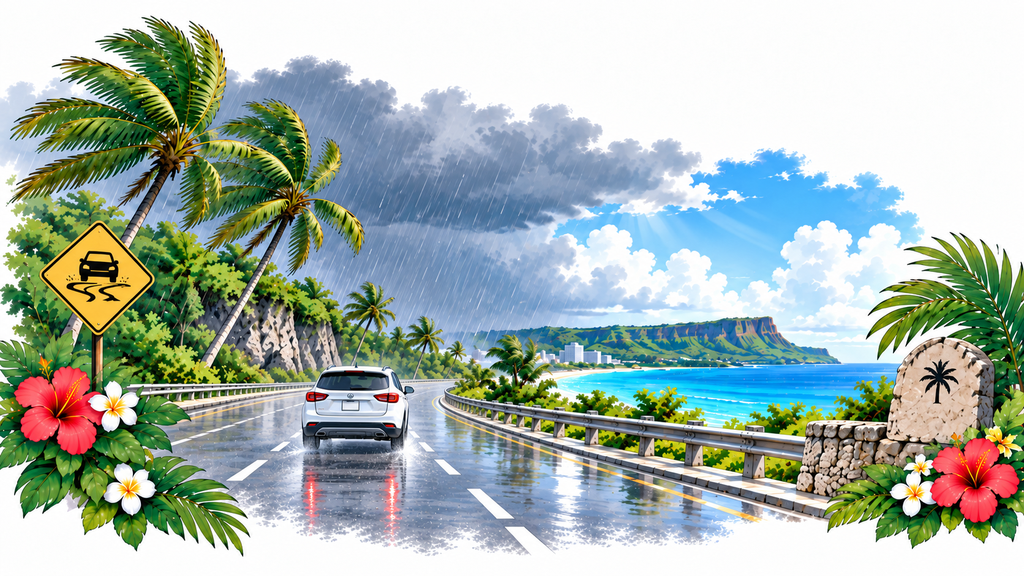
July marks the real start of Guam's wet season. Daytime highs run around 30°C, and nights offer little relief, staying near 26°C — warm and humid around the clock. Rain falls on roughly 19 days a month, averaging around 288mm, and sudden, heavy downpours are common.
July is also when typhoon risk starts climbing toward its peak — typhoons can technically form any time of year, but July through September carries the highest likelihood. If you're spending long hours outdoors for something like the Liberation Day parade, come prepared for both sun and sudden rain.
- Keep both rain gear and sun protection in the car on days with outdoor events
- Check typhoon updates daily and be ready to adjust plans if a storm's track changes
- Sudden downpours cut visibility fast — leave extra following distance
- Traffic along Marine Corps Drive gets especially heavy on Liberation Day itself, so build in extra time
Visiting Guam in July? Book Your Rental Car Early
Between Independence Day, Liberation Day, and Hågat's back-to-back fiestas, July is one of the busiest months of the year on Guam. Traffic around Marine Corps Drive spikes on parade day, and getting around the south can take longer than usual. Rates and vehicle availability tend to tighten up early this month, so once your dates are set, it's worth comparing options and booking sooner rather than later.
Featured Rental Cars
Recommended Rental Cars
The displayed price is based on a departure tomorrow. Actual prices may vary depending on your rental dates.